
Ever toss a pigskin to a buddy across the backyard? You are running complex calculations without realizing it. Your brain accounts for distance, wind resistance, and the ball’s mass. The further the target, the greater the force or steeper the angle required. It happens automatically. We call it instinct, but it is pure physics.
Physics studies the physical world. For American football, the relevant branch is mechanics, the study of motion and its causes. Three categories dominate the field:
- Delivery of a football through the air
- Runners on the field
- Stopping runners on the field
A weekend game offers more than stats. It demonstrates fundamental principles in the ball’s flight, player movement, and tackle force. This breakdown explores how these laws shape the sport.
Throwing the Football
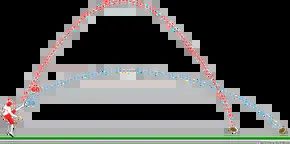
How a Punt’s Spin Changes Its Flight
The ball hangs there. Gravity is pulling it down, but inertia is pushing it forward. That tension creates the arc. It’s the same physics behind an arrow or a missile, but in football, we call it projectile motion.
When a punter strikes the ball, he isn’t just hitting a target. He’s manipulating three variables:
- Exit velocity
- Kick angle
- Rotation
That last one matters more than most casual fans realize. An end-over-end kick drags through the air. It bleeds speed quickly. A tight spiral cuts through the wind with less resistance. It stays alive longer. More hang-time. More distance. The difference between a punt pinned at your own 30 and one pinned at the opponent’s 10 often lives in that rotation.
Why Angle Determines Range and Height
The angle of contact splits the ball’s velocity into two distinct vectors. Horizontal. Vertical.
Kick it steep, and you sacrifice distance for height. The ball climbs, lingers, then drops like a stone. High hang-time, short range. Kick it flat, and the opposite happens. The ball skims. It covers ground fast but doesn’t stay up long.
This is where the punter’s brain does the work. Field position dictates the trade-off. You need the pin. You need the clock. You need the coverage. The physics doesn’t care about your strategy, but it obeys your input.
A field goal kicker faces a narrower, more brutal version of this. The ball often peaks in height before it even gets to the uprights. Miss that window by a fraction of a degree, and the ball drops short. The geometry is unforgiving.
Basic Physics Terms for Football Fans
You don’t need a calculus degree to understand why the punt bounced. But knowing the vocabulary helps you read the game.
Acceleration is how fast the speed changes over time. Final velocity minus initial velocity, divided by time. Simple math.
Force is just the push. It changes an object’s speed or direction.
Velocity is speed with direction. 20 mph north is different from 20 mph south.
Speed is just how fast you’re moving. No direction attached.
Key Numbers in the Trenches
Physics is quantitative. To really grasp the scale, look at the raw numbers Dr. David Haase of North Carolina State University put together. These are the baseline metrics for a standard NFL game:
- A player at full sprint hits about 22 miles per hour (9.8 m/s)
- A typical linebacker weighs roughly 220 pounds (98 kg)
- An offensive lineman averages around 300 pounds (133 kg)
These aren’t just stats. They’re the mass and velocity values that feed into every collision on the field.
The math behind punt hang-time and peak height
You cannot separate the physics of a great punt from the geometry of a parabola. To find punting hang-time, peak height, and range, you need two starting variables: the initial velocity (V ) off the foot and the launch angle (theta ). From there, you break the speed into vertical and horizontal pieces.
The vertical component (Vy ) uses the sine of the angle:
Vy = V sin(theta)
The horizontal component (Vx ) uses the cosine:
Vx = V cos(theta)
Once you have those, the rest is algebra.
How to calculate hang-time and distance
Total time in the air (t_total ) depends on how hard you kick it upward. In metric terms, t_total = 2Vy / g, where g is 9.8 m/s². If you are working in feet per second, the shortcut formula is t_total = 0.204 Vy.
Why does this matter? Because hang-time is what keeps the coverage unit alive. Longer air time means the punt returner has less time to gain yards before the gunners wrap up.
Maximum range (x_max ) is simply horizontal velocity multiplied by hang-time:
x_max = Vx × t_total
The ball hits its highest point exactly halfway through the flight. That time is:
t_1/2 = 0.5 × t_total
Peak height (y_max ) comes from plugging that halfway mark into the vertical position equation:
y_max = Vy(t_1/2) – 0.49(t_1/2)²
Why the 30-degree kick is the standard
Consider a punt at 90 ft/s (27.4 m/s) at 30 degrees.
Vx comes out to 23.7 m/s. Vy is 13.7 m/s.
The hang-time is 2.80 s.
The range hits 72 yards (66.4 m).
The ball peaks at 59.7 feet (18.2 m).
That is the workhorse punt. Reliable. Deep enough to pin the ball. Not so high that the returner waits forever.
But what happens if you change the angle?
Comparing kick angles: 45 vs. 60 degrees
Keep the same 90 ft/s velocity but tilt the face to 45 degrees.
Hang-time jumps to 3.96 s.
Range stretches to 84 yards (76.8 m).
Peak height soars to 120 feet (36.5 m).
This is the maximum distance you can physically achieve with that speed. 45 degrees is the sweet spot for pure distance in a vacuum.
Now try 60 degrees. Same speed. Much steeper.
Hang-time stretches to 4.84 s.
The ball peaks at 179 feet (54.5 m).
But the range drops back down to 72 yards (66.3 m).
See the trade-off? Steeper angles buy you time and height. They sacrifice distance. A kicker aiming for 60 degrees is not trying to go deep. They are trying to pin the ball near the goal line or force a return from a bad angle. The ball floats. It hangs. It does not travel as far.
The 45-degree kick maximizes distance. The 30-degree kick maximizes consistency. The 60-degree kick maximizes hang-time.
There is no single “best” angle. It depends on where the line of scrimmage is and what the coverage unit needs to do. If you need a 75-yard punt, you aim for 45. If you need to kill the clock and pin the returner, you aim for 60. The math does not lie. It just waits for you to pick the right problem to solve.
Why Backs Line Up at the Edge
Look at where the backs start. Offensive and defensive backs hang back, away from the line of scrimmage, flanking the heavy hitters. Why? They need room. Time, actually.
Linemen have almost none. They’re stuck behind the snap. But linebackers have space to accelerate. Wide receivers have even more. The further back they stand, the longer runway they have to hit top speed. A receiver can reach the highest velocity on the field because he has the most time to build it. A linebacker is faster than a lineman. A lineman is just… stuck in traffic.
The Physics of a Cut
Let’s break down a handoff. The running back takes the snap, gets the ball, and sprints right. He hits 22 mph (9.8 m/s) in two seconds. That’s an acceleration of 4.9 m/s². He’s cruising now. Constant speed. Zero acceleration.
Then he sees a gap.
He plants his foot. This is where it gets violent. He’s moving right at full speed, and he needs to stop that motion and push upfield. To do that, he applies force to the turf. But it’s not just him pushing. It’s the friction between his cleats and the grass that lets him change vector.
Without friction, you don’t turn. You slide.
Ever watch a game in the rain? Watch the runners. The water kills the coefficient of friction. The force between the foot and the ground drops. He tries to plant, but the grip fails. He loses his footing. He falls. It’s not just bad conditions. It’s the physics of reduced frictional force making it impossible to stop lateral motion.
Let’s assume dry turf. He stops his rightward motion in 0.5 seconds.
- Initial velocity: 9.8 m/s
- Final velocity: 0 m/s
- Time: 0.5 s
That’s a deceleration of -19.6 m/s². The negative sign? He’s accelerating left.
Now, the force. His mass is about 98 kg (220 lbs).
F = ma
F = (98 kg)(19.6 m/s²) = 1921 Newtons.
Convert that. 1921 N is roughly 500 lbs of force. He’s pushing 500 lbs into the ground just to stop his own sideways momentum.
Then he pushes off. Newton’s third law kicks in. He pushes the turf, the turf pushes him back. Equal and opposite. If he gets that same 0.5-second burst upfield, he’s generating that same 500 lbs of force to launch himself forward. No defender in sight? He’s at max speed until the whistle or the hit.
Momentum in the Open Field
Once he’s in space, he’s carrying maximum momentum.
Momentum (p) is mass times velocity.
For our 98 kg back at 9.8 m/s:
p = mv
p = (98 kg)(9.8 m/s) = 960 kg·m/s
Here’s the kicker. A 125 kg lineman (275 lbs) can have the exact same momentum. How? By moving slower. 7.7 m/s.
It doesn’t matter if you’re heavy and slow or light and fast. If the product of mass and velocity is the same, the “oomph” is the same. That’s why a smaller receiver can be just as hard to tackle as a massive fullback, provided he’s hitting top speed. Momentum is what you have to overcome to make a tackle. It’s the math behind the hit.

The Physics of Stopping a Running Back
It comes down to three laws. Impulse, conservation of momentum, and rotational motion. Ignore them and you get blown off the field.
Picture a running back cutting open. He is moving at 960 kg-m/s. That number isn’t arbitrary. It is the product of his mass and velocity. To stop him, you have to kill that momentum. You do it by applying an impulse in the opposite direction.
Impulse is force multiplied by time. Simple math. But it explains why a late hit feels different from a head-on block. If a defensive back wraps the runner in 0.5 seconds, the force required is:
F = impulse/t = (960 kg-m/s)/(0.5 s) = 1921 N = 423 lb
That is a massive push. But if you extend the time of contact, you lower the force needed. Drag him down over a longer duration and the impact is softer.
How Momentum Determines Who Moves
Now consider the collision itself. If no outside forces interfere, the total momentum before the hit must equal the total momentum after. Conservation of momentum is the rule.
We are looking at an elastic collision here. The players bounce off. They do not stay tangled. Three scenarios play out.
- Equal Momentum. The ball carrier and tackler have the same momentum. The forward push of the runner matches the backward push of the defender. They stop dead at the point of contact.
- Runner Has More Momentum. The ball carrier wins. He knocks the tackler backward. The momentum of that backward movement equals the difference between their initial values. The runner breaks free and accelerates away.
- Tackler Has More Momentum. The defender wins. The runner is pushed backward. His new momentum equals the difference between the two players.
Real tackles are rarely clean bounces. Usually, the tackler grabs the runner. They stay together. This is an inelastic collision. The general rules still apply. If the runner was faster, they both move forward together. If the tackler was faster, they both move backward.
But the speed drops. Why? Because the difference in momentum is now spread over the combined mass of both players, not just the lighter one. The total mass is higher, so the velocity is lower.
Center of Mass and Torque
Two terms matter when you break down the mechanics.
- Center of mass – The point in a body’s distribution of mass at which all of the mass can be considered to be concentrated.
- Torque – A force that tends to produce rotation or twisting
Understanding these shifts how a tackle lands. If you hit a runner low, you are applying torque around his center of mass. You are trying to rotate him to the ground. If you hit him high, you are trying to stop his forward translation.
The physics does not care about your helmet or your pads. It only cares about mass, velocity, and time.
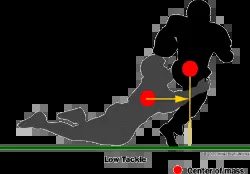
The Mechanics of Rotating a Runner’s Feet
Coaches drill this concept into linebackers and defensive backs until it’s second nature: hit low, rotate the feet. It sounds simple in a film room, but the physics are messy. When you strike a runner below the waist, the ground reaction force changes. The runner’s legs kick up. Instead of maintaining balance to accelerate forward, the momentum shifts upward and backward. The feet spin in the direction of the tackle.
This isn’t just about knocking someone down. It’s about disrupting their center of gravity before they can plant a foot for the next stride.
Why Low Tackles Change the Geometry of the Play
Think about a running back cutting to the outside. If you wrap up his chest, he absorbs the hit. He might stumble, but he keeps moving. If you dive at his midsection, you’re fighting his hip. You’re a smaller mass hitting a larger one at a similar height.
But if you slide underneath? You’re hitting his legs. The leverage is different. The runner’s upper body is still traveling forward, but the lower body is being stopped abruptly. That creates a torque effect. The legs go up. The runner tumbles forward.
“You’re not tackling his body. You’re tackling his ability to run.”
This is why defensive coordinators emphasize “high arms, low hips” in technique. If your hips are up, you’re a fullback tackling another fullback. If your hips are down, you’re a wrestler taking down a guy twice your size.
How Foot Rotation Affects Yardage
The immediate result is minimal, but the cumulative effect is massive. A runner who gets his feet rotated loses half a step. That half a step is the difference between a 4-yard gain and a 2-yard gain. Over a game, that’s hundreds of yards.
Teams that win the “low tackle” battle consistently stop the run game in the second half. It’s not about the star cornerback taking a guy out at the goal line. It’s about the middle linebacker driving a fullback into the turf with his feet flying up in the air.
Which Players Benefit Most From This Technique?
Smaller defenders gain the most. A 220-pound linebacker can’t out-muscle a 250-pound running back if he’s trying to hit chest-to-chest. But if he can get under the pads, the size difference matters less. The leverage wins.
It’s also why special teams players are drilled on this. A punt returner who gets his feet kicked up is finished. The play is dead. The low tackle is the ultimate weapon for ending a drive, not just limiting a gain.
Does it work every time? No. Elite running backs with quick feet can sometimes shuffle out of the rotation. But the principle holds. You can’t run if your feet are spinning in the air.
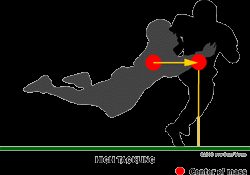
The Physics of the Low Tackle
Think of a runner not as a person, but as a lump of mass centered at a single point. That point is the center of mass. For men, it sits right around the navel. For women, it drops lower, closer to the hips.
Rotation happens around that point. Always. If you push somewhere else, you create torque.
Torque equals force multiplied by distance from the center of mass.
This simple math changes how you defend. Because torque is a product, you can cheat. Apply less force farther away from the pivot point. Apply more force closer in. Same result.
That is why you hit low.
When a defender wraps up a runner’s legs, they are applying force far from the center of mass. The distance lever does the heavy lifting. You do not need to generate massive power to rotate the body. The geometry handles it.
Hit high? Near the center of mass? You lose that lever. Now you are just shoving weight against weight. The runner does not tip. He drives forward. You stall him. You do not tackle him.
Why does this matter? Because leverage is free power.
Tackling low exploits the rotational nature of human movement. It turns a contest of strength into a problem of geometry. The defender wins the angle. The runner loses his base.
How Distance Changes Required Force
Let’s break down the trade-off.
- High Contact Point : Small distance from center of mass. You need high force to create the same torque.
- Low Contact Point : Large distance from center of mass. You need lower force to create that same torque.
This is not theory. It is how elite tacklers think. They do not aim for the chest. They aim for the thighs. The further out from the pivot you hit, the easier it is to spin the body off its axis.
But there is a trap.
If you hit exactly at the center of mass, no rotation occurs. The runner moves in the direction of the force. Straight line. No spin. Just translation.
This is why timing and angle matter so much in pass rush and run defense. You want to get behind the center of mass or wrap around it. You want to create a lever arm.
Where the Pivot Point Actually Sits
The location of the center of mass shifts with posture and movement.
- Standing upright : Near the navel for men.
- Running forward : Shifts slightly forward as the body leans.
- Wrapping up low : Forces the center of mass to rotate over the legs.
This is why a runner who hits you high and flat often stays on his feet. You pushed him in line with his motion. You added speed. You did not remove balance.
When you get under him, you change the vector. Now you are applying torque. The body rotates. The balance breaks.
The math is unforgiving. Force times distance equals torque. Change the distance. Change the outcome.
Why High Tackles Feel Heavier
It feels heavier because it is heavier.
When you engage a runner at shoulder height, you are working against his momentum and his mass directly. There is no lever. You are in a direct collision. The force you
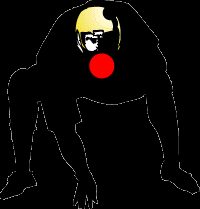
Why Staying Low Wins the Red Zone Battle
Coaches drill it into linemen for a reason. Keep your hips down. Lower your center of mass.
When you stay low, the opposing player hits you right at your equilibrium point. No matter how aggressively they push, you don’t rotate. You don’t spin off your feet. This makes moving you exponentially harder.
In the red zone, that last 10 yards before the goal line, this stability is the difference between a sack and a loss. A defensive lineman who stays planted can defend his own goal effectively because the physics of contact favors the low man.
The Instinct Behind the Physics
We’ve only scratched the surface of how mechanics drive the game.
Most players and coaches don’t consciously calculate torque or force vectors during a play. It feels instinctive. But translating those instincts into physics language changes how you see the field. You start to appreciate just how physically demanding those feats are.
It’s not just about speed. It’s about energy transfer, center of gravity, and leverage.
Applying this knowledge has real-world benefits. It leads to safer equipment. It shapes rule changes. It helps athletes improve performance. And it deepens your connection to the game itself.
The next time you watch a lineman hold the line, remember: he’s not just strong. He’s managing his center of mass.
If you want to dig deeper into the mechanics of the sport, resources from physics departments and specialized science hubs offer a lot more detail. For example, Dr. David Haase at North Carolina State University in Raleigh, NC, has done significant work connecting physics to football. Other sources, like the Exploratorium or the American Institute of Physics, break down topics like force, power, and how the first-down line works in televised games.
It’s a different way to watch the game. But maybe the best way to truly understand it.